How to Build a Wardrobe Around Clothes You Already Own
Building a wardrobe around clothes you already own is less about buying the perfect basics and more about seeing useful combinations in what is already hanging in your closet. A blazer can become a weekend layer, an overlooked skirt can work with a sweatshirt, and the right accessories can make familiar pieces feel fresh.
The process saves money, reduces unnecessary purchases, and gives your personal style more consistency. By auditing your clothing, identifying reliable outfit formulas, and filling only genuine wardrobe gaps, you can create a practical closet that feels more like you without starting over.
Start With a Real Wardrobe Audit
The first answer is simple: begin with a complete wardrobe audit before buying anything new. Take every garment out of drawers, closets, laundry baskets, and storage boxes so you can see the full picture rather than relying on memory.
Lay items by category, such as trousers, jeans, skirts, dresses, knitwear, shirts, jackets, coats, shoes, bags, and accessories. This often reveals a useful truth: many people don’t lack clothing; they lack a clear view of what they own and how the pieces relate to one another.
Make four groups as you sort: wear often, wear sometimes, need repair or alteration, and don’t wear. The last group should not automatically go into a donation bag, because an item may be unworn simply because its fit is wrong, its matching pieces are missing, or it has been stored where you never see it.
Try on anything that feels uncertain. A garment that looked attractive on a hanger may pull across the shoulders, sit awkwardly at the waist, or need a different bra or base layer, while an older item may look excellent once its garment fit is reassessed.
Record What Gets Worn
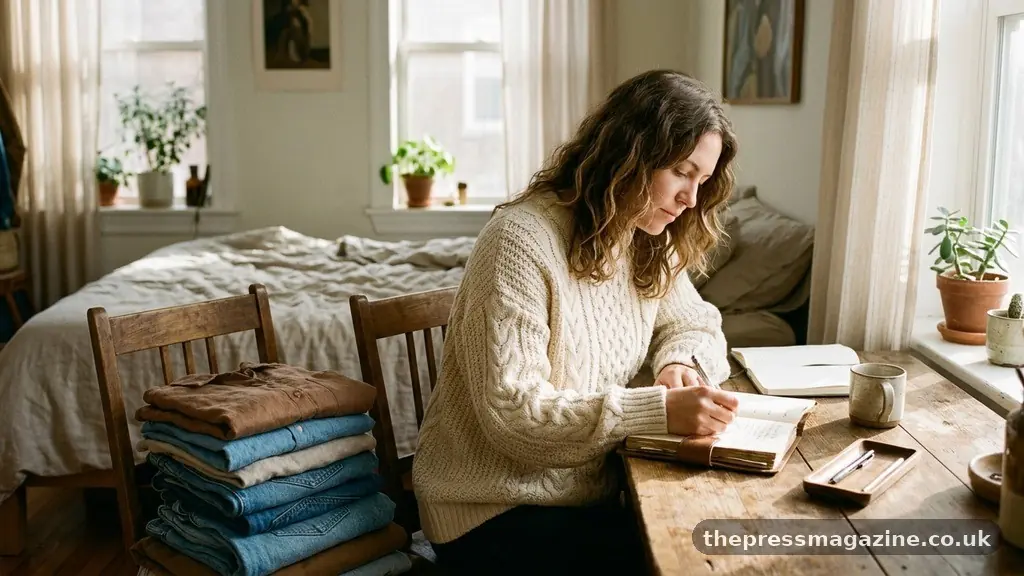
For two weeks, note what you actually reach for each morning. Record the outfit, the weather, your activity, and what made the combination work or fail.
This informal closet inventory is more useful than an aspirational list of clothes you wish you wore. If you repeatedly choose straight-leg jeans, soft shirts, and an unstructured jacket, that pattern tells you more about your real lifestyle than a mood board filled with formal tailoring.
- Mark pieces worn at least twice during the tracking period.
- Note garments that generate compliments or make you feel comfortable and confident.
- Write down items that require constant adjusting, special underwear, or inconvenient care.
- Photograph successful outfits so you can recreate them quickly.
Don’t judge your preferences during this stage. The goal is evidence, not a forced makeover. Your most useful wardrobe may be built around clothes that already support commuting, childcare, travel, creative work, or relaxed weekends.
Find the Style Patterns Already Present
After sorting, look for repeated shapes, fabrics, colors, and proportions. Perhaps nearly every outfit includes a defined waist, a cropped jacket, a straight trouser, or a low-profile shoe; those recurring choices are clues to your personal style.
Style becomes easier to build when you name these preferences in practical terms. “Polished but relaxed,” “soft and minimal,” or “colorful with tailored shapes” gives you a useful direction without forcing you into a rigid fashion category.
Next, identify your most successful outfit formulas. An outfit formula is a repeatable structure, not a uniform: wide-leg trousers plus a fitted knit and a short jacket, or jeans plus a button-down shirt, a cardigan, and loafers.
Turn Favorites Into Formulas
Choose three to five outfits you already wear and break each one into parts. Ask what role each garment plays, such as base, structure, texture, contrast, warmth, or visual interest.
For example, a floral dress may work because a denim jacket tones it down and ankle boots give it weight. The lesson isn’t that you need more floral dresses; it’s that a casual outer layer and substantial footwear help you wear a delicate piece in a way that feels natural.
Write formulas using categories rather than brand names. “Relaxed trouser + fitted top + long cardigan” can be recreated with several items, while “navy trousers + cream sweater + tan belt” describes only one combination.
When you understand the structure, clothing versatility increases. One jacket can serve as the finishing layer for trousers, dresses, denim, and skirts instead of sitting unused because you only associate it with one particular shirt.
Separate Fantasy From Function
Some garments belong to an imagined lifestyle: dramatic heels for events that rarely occur, delicate fabrics for a commute involving crowded trains, or formal trousers with no comfortable tops to balance them. These pieces aren’t morally wrong, but they shouldn’t dominate your wardrobe decisions.
Keep genuine occasionwear if you enjoy it and have a realistic place to wear it. Simply separate it from your everyday system so a rarely used evening dress doesn’t make you think your daily closet is failing.
Build a Color Palette From What You Own
A coherent color palette makes existing clothes easier to combine. Start by identifying the colors that appear most often in your favorite garments, then divide them into a few neutrals, one or two supporting shades, and optional accent colors.
Your neutrals might be black, navy, cream, gray, brown, olive, denim, or camel. They don’t need to match perfectly, and your palette doesn’t have to follow a conventional seasonal scheme.
Use the clothes you genuinely wear as evidence. If your closet contains black trousers, blue denim, white shirts, burgundy knitwear, and silver accessories, building around those colors will probably feel more natural than introducing beige and gold because a style checklist recommends them.
Use Color to Connect Separate Pieces
Look for small color relationships that can make an outfit feel intentional. A burgundy shoe can echo a burgundy stripe in a shirt, while a cream bag can repeat the warmth of a sweater without creating an overly matched appearance.
Color repetition works especially well with mix-and-match outfits. A jacket that seems incompatible with most of your closet may become useful when you repeat one of its colors in a scarf, belt, shoe, or printed top.
Don’t discard a garment because it sits outside your main palette. A strong accent can add energy, particularly when worn with two quiet neutrals.
Accessories styling provides an inexpensive way to test a color before buying another garment. Try a bright bag, patterned scarf, colorful earrings, or lipstick with several existing outfits and observe which combinations feel comfortable rather than merely eye-catching.
Consider Contrast and Proportion
Color is also about contrast. Dark trousers with a pale shirt create a sharper visual break than medium denim with a gray knit, while similar shades from head to toe can create a longer, quieter line.
If an outfit feels disjointed, try changing contrast before replacing the clothes. A belt, open jacket, half-tuck, or shoe in a connecting shade may solve the problem.
| Wardrobe element | Useful question | Practical adjustment |
|---|---|---|
| Main neutral | Which color appears in several bottoms or outer layers? | Use it as the anchor for everyday outfits. |
| Supporting shade | Which color repeats in tops, knits, or accessories? | Pair it with the main neutral for easy coordination. |
| Accent color | Which brighter shade makes favorite outfits feel alive? | Use it in one item at a time before expanding. |
| Patterned piece | Which colors does the print already contain? | Repeat one quiet color elsewhere in the outfit. |
Test Clothing Versatility With Outfit Experiments
Once you understand your palette and formulas, create deliberate outfit experiments. Choose one item that feels underused and style it in at least three different ways using only your current wardrobe.
A pleated midi skirt might pair with a tucked T-shirt and sneakers, a fine-gauge sweater and boots, or a crisp shirt and loafers. These combinations cover casual, comfortable, and more polished settings without requiring a new skirt.
Use a full-length mirror and take photographs from the front and side. Images can reveal proportions that are difficult to notice while moving quickly through a morning routine.
Work From the Hardest Piece
The most challenging garment is often the best starting point. If a statement jacket only works with one pair of trousers, test it with denim, a simple dress, a skirt, and different shoe weights.
Change one variable at a time so you learn what affects the result. If swapping heels for trainers makes the jacket feel too formal, the issue may be footwear rather than the jacket itself.
Layering pieces deserve special attention because they multiply combinations. An overshirt, cardigan, vest, blazer, or lightweight knit can change the temperature, formality, and silhouette of several outfits.
Try open and closed styling, sleeves pushed up or left long, and hems tucked or untucked. Small changes can make the same clothing appear purposeful rather than repetitive.
Use a Three-Combination Test
Before deciding that an item is a wardrobe gap, try to make three complete outfits around it. Include appropriate shoes, outerwear, underwear, and accessories, since a garment’s usefulness cannot be judged in isolation.
If you can create three outfits for different settings, the item is probably worth keeping in regular rotation. If every combination requires another purchase, pause before shopping and ask whether the item suits your actual lifestyle.
Save successful combinations in a phone album. On busy mornings, a visual menu of proven outfits is faster than staring at a full closet and concluding that nothing works.
Create a Small Core Without Starting From Scratch
A capsule wardrobe doesn’t have to mean owning a fixed number of garments or wearing only plain colors. In this context, it means identifying a dependable core that supports most of your week.
Your core might include two pairs of trousers, a pair of jeans, several tops, a knit layer, a jacket, comfortable shoes, and one practical coat. The exact number depends on laundry habits, climate, dress code, and how often you need different outfits.
Choose items based on actual use rather than an internet checklist. Someone who works from home may need more comfortable separates, while someone in a formal office may need several structured layers and fewer casual T-shirts.
Identify Wardrobe Essentials by Role
Instead of asking whether you own a white shirt or a trench coat, ask whether your wardrobe has the functions you need. Can you create a warm outfit, a polished outfit, a rainy-day outfit, and a comfortable travel outfit?
This role-based approach makes wardrobe essentials personal. A washable overshirt may be more essential to one person than a blazer, and flat boots may be more valuable than dress shoes if most days involve walking.
Group your existing pieces by function:
- Foundation items: trousers, jeans, skirts, dresses, and simple tops used repeatedly.
- Layering pieces: cardigans, shirts, vests, jackets, and lightweight sweaters that alter an outfit.
- Practical footwear: shoes suited to walking, weather, work, and ordinary errands.
- Finishing pieces: belts, bags, scarves, jewelry, and hats that add connection or contrast.
- Occasion items: clothing reserved for celebrations, ceremonies, performances, or formal work.
Once the roles are clear, you can spot a missing function without buying duplicates. You may not need another top; you may need a layer that makes your existing tops wearable across more temperatures.
Fill Wardrobe Gaps Carefully
A wardrobe gap is not simply an item you don’t own. It is a repeated dressing problem that prevents several existing pieces from being worn.
For example, if four tops work beautifully with your trousers but none feels right under your jackets, the gap may be a smooth, low-bulk base layer. If your dresses are rarely worn because every shoe feels too formal, the missing item may be a comfortable everyday shoe.
Write each problem as a sentence before shopping. “I need something” is too vague, while “I need a washable, mid-weight layer that works over sleeveless dresses and under my raincoat” creates useful boundaries.
Rank Purchases by Impact
Prioritise a purchase that connects several existing items. One versatile jacket that works with five bottoms usually has more impact than a distinctive top that works with only one outfit.
Consider cost per wear rather than the ticket price alone. A higher-quality coat worn three times a week for several seasons may provide more value than a low-cost statement piece worn once because it doesn’t integrate with your closet.
Do not treat cost per wear as permission to overspend. It is a decision tool, not a reason to buy something expensive or to ignore repair, care, comfort, and ethical concerns.
Before purchasing, create at least three outfits in your mind using garments you already own. If you cannot name the shoes, layers, and settings, the item may be attractive but not useful.
Use a Waiting Period
Keep a short shopping list and wait before acting on it. A week or two often reveals whether the gap is genuine or whether you simply noticed a trend online.
During the waiting period, borrow, alter, layer, or restyle what you have. A tailor may shorten trousers, replace buttons, adjust a waist, or repair a hem for less money and less disruption than replacing a garment.
Manage Seasons and Care
Seasonal wardrobe rotation can make existing clothes feel fresh without adding anything. At the change of season, store only items that are genuinely unsuitable for current weather, then bring them back gradually rather than displaying every garment at once.
Before storing clothing, clean it according to its care label and repair visible damage. The Federal Trade Commission’s clothing care label guidance explains how care instructions communicate washing, drying, bleaching, ironing, and professional-cleaning needs.
Use breathable storage for natural fibers and avoid compressing delicate garments for long periods. Fold knits to reduce stretching, hang structured jackets on supportive hangers, and keep shoes clean enough that they can move directly back into rotation.
Build Around Your Actual Climate
Weather should shape your wardrobe system. Someone in a rainy climate may need several water-resistant layers, while someone in a hot region may get more value from breathable fabrics, washable dresses, and lightweight overshirts.
Think in temperature ranges rather than seasons alone. A thin knit, shirt, and light jacket can cover a broader part of the year than a heavy sweater that works for only a few cold weeks.
Layering also protects your personal style from unpredictable weather. You can keep wearing a favorite dress by adding tights, a warm knit, boots, and a coat instead of abandoning it until the temperature is perfect.
Repair Before Replacing
Small maintenance decisions preserve the clothing you already understand and enjoy. Replace loose buttons, mend minor tears, remove pilling carefully, and refresh tired shoes before assuming the whole outfit needs rebuilding.
Repairs can also reveal which garments matter. If you immediately miss an item while it’s being fixed, that is evidence of real use; if its absence changes nothing, it may not deserve valuable storage space.
Make Getting Dressed Easier Every Morning
A well-built wardrobe should reduce decisions, not create a new styling project each day. Keep the most useful pieces visible and group clothing in a way that matches how you dress, such as by outfit type, color family, or work and weekend use.
Some people benefit from hanging complete outfit ideas together, while others prefer separate categories and a small rack of current favorites. There is no correct arrangement if it helps you see combinations quickly.
Keep a few reliable outfit formulas ready for predictable situations. A work formula, a casual formula, a rainy-day formula, and a dinner formula can remove pressure when time is short.
Use Accessories as the Final Step
Accessories can change the personality of familiar clothing without taking much closet space. A belt can define a loose silhouette, a structured bag can sharpen casual denim, and a scarf can connect colors across an outfit.
Keep accessories where you can see them. If jewelry is buried in a box or belts are hidden behind shoes, you will probably repeat the same finishing choices even when more interesting options are available.
Try one deliberate change at a time. Switching earrings, shoes, or a bag may be enough to move an outfit from practical daytime clothing to something suitable for dinner.
Review the System Regularly
Every few months, revisit your wardrobe audit and update your notes. Changes in work, health, climate, hobbies, body measurements, or daily travel can alter what you need.
Don’t measure success by how small your closet becomes. A successful wardrobe is one where your clothes fit your life, your favorite pieces are accessible, and shopping becomes an occasional solution rather than the main styling strategy.
Frequently Asked Questions
How many clothes do I need to build a functional wardrobe?
There is no universal number. The right amount depends on laundry access, climate, work requirements, social activities, and how often you want to repeat outfits; functionality matters more than reaching a specific capsule wardrobe count.
What should I do with clothes that don’t fit right now?
Separate them from your active wardrobe and store only a manageable number of meaningful pieces. If an item needs major alteration, has not been worn for a long time, or makes you uncomfortable, be honest about whether keeping it supports your current life.
How can I make old clothes look less repetitive?
Change the styling variables rather than replacing the garment. Try different proportions, footwear, layering pieces, hair, jewelry, belts, or color combinations, and photograph the results so successful variations become easy to repeat.
Should I choose a strict color palette?
No. A loose palette is usually more practical than a strict one, because it gives your closet visual connection while leaving room for meaningful colors, patterns, and seasonal changes.
When is it time to buy something new?
Buy when a repeated dressing problem remains after you have tried existing combinations, repairs, and alterations. The strongest purchase usually solves several wardrobe gaps and works with at least three items already in your closet.
Build From What Already Works
Building a Wardrobe Around Clothes You Already Own starts with observation: notice what fits, what gets worn, what combines easily, and what repeatedly causes frustration. A wardrobe audit, practical outfit formulas, and a flexible color palette can turn scattered garments into a system that supports real mornings.
Start with one category this week, photograph three successful outfits, and write down the single gap that causes the most inconvenience. That small step can make your closet calmer, more personal, and far less dependent on constant shopping.