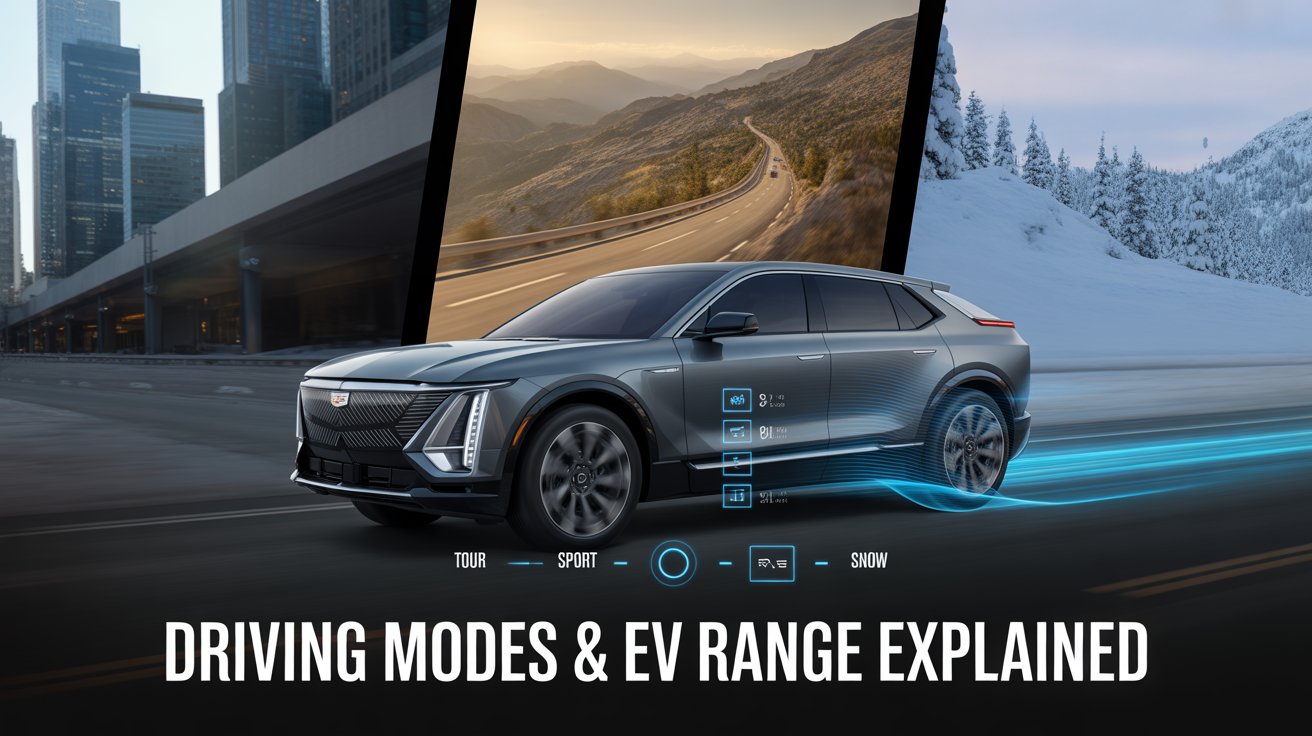
Electric vehicles have introduced a new dimension to driving, where performance, efficiency, and user control intersect in sophisticated ways. Among premium electric SUVs, the Cadillac Lyriq stands out for its refined driving experience and advanced technology suite. One of the most frequently asked questions among prospective buyers and EV enthusiasts alike is: Do the Driving Modes in Cadillac Lyriq Offer Different Ranges or Battery Usages?
Understanding how driving modes affect range and energy consumption requires more than a simple yes or no answer. It involves examining how software, driver behavior, and environmental conditions collectively influence battery usage.
Understanding Driving Modes in the Cadillac Lyriq
The Cadillac Lyriq offers multiple driving modes designed to adapt the vehicle’s behavior to different road conditions and driving preferences. These modes include:
- Tour Mode
- Sport Mode
- Snow/Ice Mode
- My Mode (customizable)
Each mode alters specific parameters such as throttle response, steering feel, and torque delivery. However, they do not fundamentally change the battery’s chemical efficiency or core energy management system.
This brings us again to the central question: Do the Driving Modes in Cadillac Lyriq Offer Different Ranges or Battery Usages? The answer lies in how these modes influence driving patterns rather than directly modifying battery consumption algorithms.
How Battery Usage Works in Electric Vehicles
Before diving deeper, it is essential to understand how energy consumption operates in EVs. Unlike internal combustion engines, electric vehicles rely on battery discharge rates that are influenced by:
- Acceleration intensity
- Speed consistency
- Terrain and incline
- Weather conditions
- Regenerative braking efficiency
Driving modes in the Lyriq act as behavioral modifiers. They guide how power is delivered rather than redefining how energy is stored or consumed at a chemical level.
Tour Mode: Efficiency-Oriented Driving
Tour Mode is the default setting in the Cadillac Lyriq and is optimized for everyday driving. It provides:
- Smooth acceleration
- Balanced steering
- Controlled torque delivery
In practical terms, Tour Mode encourages energy-efficient driving habits. Drivers are less likely to engage in aggressive acceleration, which helps conserve battery power.
So, Do the Driving Modes in Cadillac Lyriq Offer Different Ranges or Battery Usages? In Tour Mode, the answer leans toward improved range—not because of a different battery algorithm, but because the mode promotes efficiency-friendly driving behavior.
Sport Mode: Performance at a Cost
Sport Mode transforms the Lyriq into a more dynamic and responsive vehicle. It enhances:
- Throttle sensitivity
- Steering weight
- Immediate torque delivery
While exhilarating, Sport Mode often leads to higher energy consumption. Rapid acceleration and sustained high power output naturally draw more energy from the battery.
This raises the question again: Do the Driving Modes in Cadillac Lyriq Offer Different Ranges or Battery Usages? Yes—but indirectly. Sport Mode does not inherently reduce efficiency at a system level, but it encourages driving habits that consume more energy, thereby reducing overall range.
Snow/Ice Mode: Stability and Controlled Energy Use
Snow/Ice Mode is engineered for low-traction conditions. It modifies:
- Torque distribution
- Acceleration smoothness
- Wheel slip prevention
Interestingly, this mode can sometimes help preserve energy. By minimizing wheel spin, it prevents wasted power—a subtle yet meaningful factor in efficiency.
However, external factors such as cold temperatures significantly impact battery performance. Even if Snow/Ice Mode helps optimize traction, colder climates inherently reduce range.
Thus, when asking Do the Driving Modes in Cadillac Lyriq Offer Different Ranges or Battery Usages?, Snow/Ice Mode demonstrates how efficiency can improve through better traction management rather than direct energy savings.
My Mode: Personalized Driving Dynamics
My Mode allows drivers to customize:
- Steering feel
- Acceleration response
- Brake responsiveness
This flexibility means drivers can create a profile that balances performance and efficiency according to their preferences.
If configured conservatively, My Mode can mimic or even surpass Tour Mode in efficiency. If tuned aggressively, it may resemble Sport Mode and consume more energy.
Therefore, Do the Driving Modes in Cadillac Lyriq Offer Different Ranges or Battery Usages? With My Mode, the answer becomes highly dependent on user configuration.
The Role of Driver Behavior
One of the most critical insights is that driver behavior outweighs mode selection in determining range. For instance:
- Gentle acceleration conserves energy
- Maintaining steady speeds improves efficiency
- Utilizing regenerative braking extends range
Even in Sport Mode, a cautious driver may achieve better efficiency than an aggressive driver in Tour Mode.
This reinforces the nuanced answer to Do the Driving Modes in Cadillac Lyriq Offer Different Ranges or Battery Usages?—the modes influence behavior, and behavior dictates energy usage.
Regenerative Braking and Energy Recovery
The Cadillac Lyriq incorporates advanced regenerative braking systems that recover energy during deceleration. Driving modes can subtly affect how regenerative braking feels, but the underlying system remains consistent.
Drivers who maximize regenerative braking can significantly extend range, regardless of the selected mode.
Again, Do the Driving Modes in Cadillac Lyriq Offer Different Ranges or Battery Usages? Not directly—but they shape how effectively drivers utilize energy recovery systems.
External Factors That Matter More Than Modes
While driving modes play a role, several external factors have a more substantial impact on battery usage:
Temperature
Cold weather reduces battery efficiency and increases energy consumption for heating.
Speed
Highway driving at sustained high speeds drains the battery faster than city driving.
Terrain
Uphill driving requires more energy, while downhill driving allows regeneration.
Load
Carrying passengers or cargo increases energy demand.
Compared to these variables, the influence of driving modes is relatively secondary.
Real-World Range Implications
In real-world conditions, the difference in range between modes may not be dramatic unless driving style changes significantly.
For example:
- Tour Mode with smooth driving may yield maximum range
- Sport Mode with aggressive driving may reduce range noticeably
- Snow/Ice Mode may stabilize efficiency in challenging conditions
So, Do the Driving Modes in Cadillac Lyriq Offer Different Ranges or Battery Usages? Yes—but primarily through indirect behavioral changes rather than direct system modifications.
Psychological Influence of Driving Modes
Driving modes also have a psychological effect. When drivers select Sport Mode, they are more likely to drive aggressively. Conversely, Tour Mode encourages relaxed driving.
This psychological component plays a surprisingly large role in energy consumption, further emphasizing that the answer to Do the Driving Modes in Cadillac Lyriq Offer Different Ranges or Battery Usages? is rooted in human behavior as much as engineering.
Engineering Perspective: Software vs Hardware
From an engineering standpoint, the battery system remains consistent across all modes. The Battery Management System (BMS) does not switch efficiency profiles based on driving mode.
Instead, the modes adjust:
- Power delivery curves
- Pedal mapping
- Steering calibration
Thus, Do the Driving Modes in Cadillac Lyriq Offer Different Ranges or Battery Usages? Not at the hardware level—but certainly at the user interaction level.
Comparison with Other Electric Vehicles
Many modern EVs follow a similar philosophy. Driving modes typically:
- Adjust responsiveness
- Influence comfort
- Encourage certain driving styles
Very few vehicles alter actual battery efficiency through modes. The Lyriq aligns with this industry standard, offering refinement without compromising system consistency.
Practical Tips to Maximize Range
To optimize battery usage in the Cadillac Lyriq:
- Use Tour Mode for daily commuting
- Avoid sudden acceleration
- Maintain steady speeds
- Utilize regenerative braking
- Precondition the battery in cold weather
These practices matter far more than simply switching modes.
FAQs
Do the Driving Modes in Cadillac Lyriq Offer Different Ranges or Battery Usages?
They influence range indirectly by altering driving behavior, not by changing battery efficiency.
Which mode provides the best range?
Tour Mode typically delivers the best range due to its balanced and smooth power delivery.
Does Sport Mode drain the battery faster?
Yes, but mainly because it encourages aggressive acceleration and higher energy consumption.
Is Snow/Ice Mode more efficient?
It can prevent energy waste from wheel spin, but cold temperatures often reduce overall efficiency.
Can My Mode improve range?
Yes, if configured for smoother acceleration and efficiency-focused settings.
Vehicle Overview Table
| Feature Category | Details |
|---|---|
| Model Name | Cadillac Lyriq |
| Vehicle Type | Luxury Electric SUV |
| Driving Modes | Tour, Sport, Snow/Ice, My Mode |
| Battery System | Ultium Platform |
| Primary Focus | Comfort, Technology, Efficiency |
| Range Influence | Behavior-driven, not mode-driven |
| Regenerative Braking | Standard with advanced control |
| Customization | High (via My Mode) |
A Broader Perspective on Driving Intelligence
Rather than viewing driving modes as direct range modifiers, it is more accurate to see them as tools that shape the driving experience. They provide flexibility, adaptability, and personalization—qualities that define modern electric mobility.
Ultimately, the repeated inquiry—Do the Driving Modes in Cadillac Lyriq Offer Different Ranges or Battery Usages?—reveals a deeper truth: efficiency in electric vehicles is a partnership between technology and the driver. The Lyriq excels in offering both control and refinement, allowing drivers to tailor their experience without fundamentally altering the integrity of the battery system.